Manual Bauknecht FWM 8F4 Washing Machine

Need a manual for your Bauknecht FWM 8F4 Washing Machine? Below you can view and download the PDF manual for free in English. This product currently has 12 frequently asked questions, 1 comment and has 0 votes. If this is not the manual you want, please contact us.

Is your product defective and the manual offers no solution? Go to a Repair Café for free repair services.

Manual

Loading…
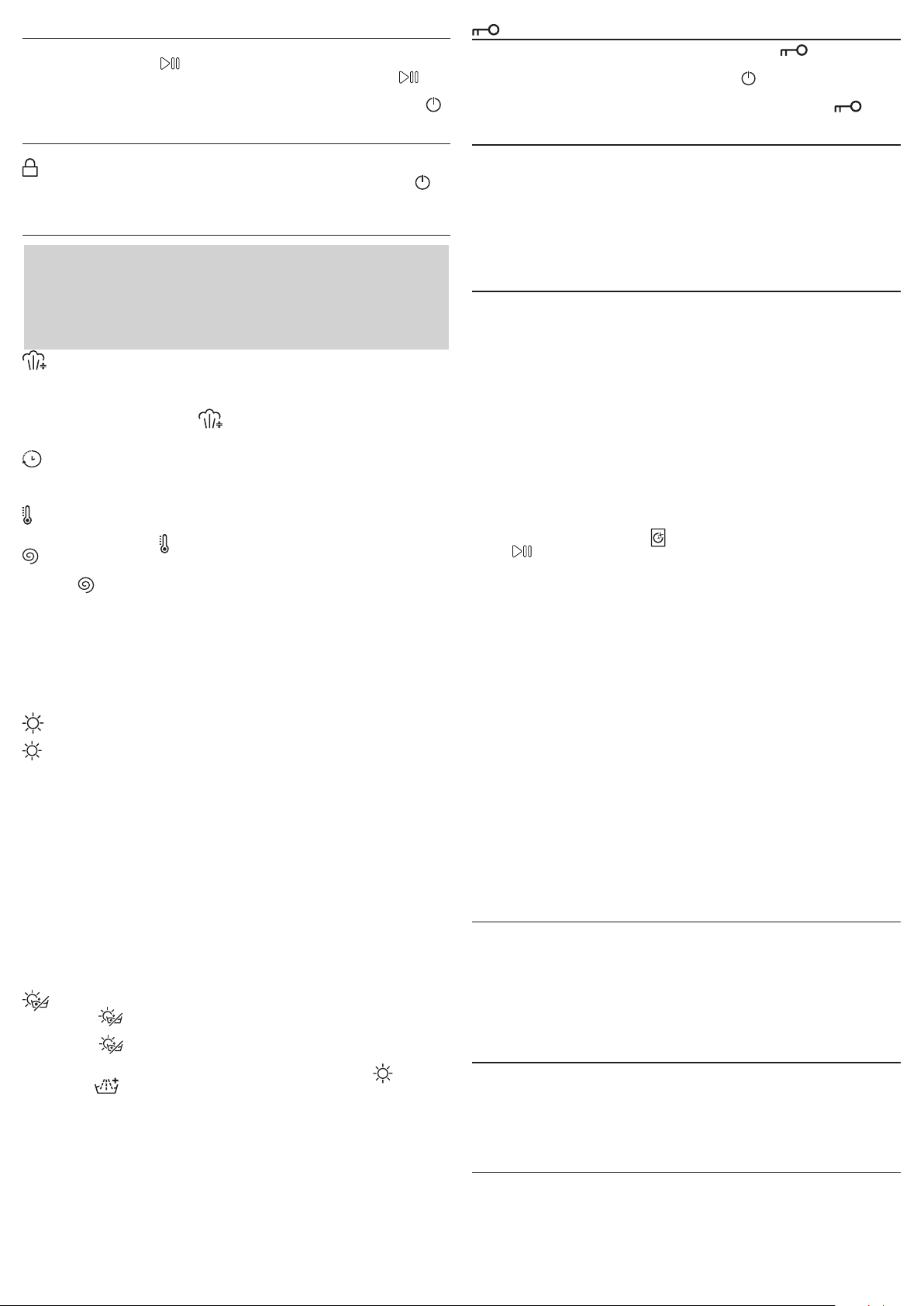
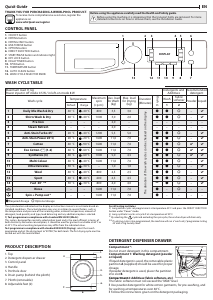
CHANGING A RUNNING WASH CYCLE
To change a wash cycle while it is in progress, pause the washing machine
using the START/PAUSE button (the relative indicator light will ash
amber), then select the desired cycle and press the START/PAUSE
button again.
! To cancel a cycle that has already begun, press and hold the ON/OFF
button. The cycle will be stopped and the machine will switch o.
AT THE END OF THE WASH CYCLE
This will be indicated by the word “CYCLE END” on the display; when the
symbol switches o, the door may be opened. Open the door, unload
the laundry and switch o the machine. If you do not press ON/OFF
button, the washing machine will switch o automatically after about a
half of an hour.
OPTIONS
- If the selected function is incompatible with the set wash cycle, the
relevant indicator light will appear dimly lit; the incompatibility will also
be signalled by a buzzer (3 beeps) and the wording Not Selection will
appear on the display.
- If the selected function is incompatible with another previously set
function, the wording Not Selection will appear on the display and
the function will not be enabled.
Steam Hygiene
This option enhances washing performance by generating steam during
the wash cycle to remove any bacteria from the bres, which are treated
at the same time. Place the laundry in the drum, choose a compatible
programme and select option .
! The steam generated during the operation of the washer-dryer may
cause the porthole door to become hazy.
Delay Timer
To set a delayed start for the selected cycle, press the corresponding button
repeatedly until the desired delay period is reached. To remove the delayed
start setting, press the button until -- h appears on the display.
Temperature
Each wash cycle has a pre-dened temperature. To modify the
temperature, press the button. The value will appear on the display.
Spin
Each wash cycle has a pre-dened spin speed. To modify the spin speed,
press the button. The value will appear on the display.
Direct Injection
The washer-dryer is equipped with the innovative technology «Direct
Injection» which pre-mixes water and detergent, thus immediately
activating the detergent’s cleaning principles. This active emulsion is
directly introduced into the drum of the washer-dryer and penetrates the
bres with more ecacy in cleaning even heavily soiled garments at low
temperatures, fully preserving colours and fabrics.
The mode «Power» ensures the best cleaning performance and the mode
«EcoEnergy» allows more energy saving.
Drying
The desired drying cycle type may be set by pressing the DRYING button
once or several times. Two options are available:
A - Based on the how damp the clothes are once they have been dried:
Iron: suitable for clothes which will need ironing afterwards. the
remaining dampness softens creases, making them easier to remove.
Hanger: ideal for clothes which do not need to be dried fully.
Cupboard: suitable for laundry which can be put back in a cupboard
without being ironed.
Extra: suitable for garments which need to be dried completely, such as
sponges and bathrobes.
B - Based on a set time period: between 30 and 180 minutes.
To exclude the drying phase press the relevant button until the text OFF
appears on the display.
If your laundry load to be washed and dried is much greater than the
maximum stated load, perform the wash cycle, and when the cycle is
complete, divide the garments into groups and put some of them back
in the drum. At this point, follow the instructions provided for a “Drying
only” cycle. Repeat this procedure for the remainder of the load. A
cooling-down period is always added to the end of each drying cycle.
Drying only
Press button to perform the drying-only cycle.
After selecting the desired cycle (compatible with the type of garments),
press button to exclude the washing phase and start the drying
phase at the maximum level for the selected cycle. The drying level or
time may be set and changed by pressing the drying button .
Multi Rinse
This option allows for selecting the desired rinse type to protect sensitive
skin. Press the button once to set level Extra +1, which allows for
selecting an additional rinse to the standard cycle rinses and removing all
traces of detergent. Press the button again to set level Extra +2, which
allows for selecting two additional rinses to the standard cycle rinses; this
cycle is recommended for very sensitive skin. When the button is pressed
for the third time, the Extra +3 level is set, which allows for selecting
3 additional rinses to the standard cycle rinses. When started with
cycles at a temperature of 40°C, this option makes it possible to remove
major allergens such as pollen and cat or dog hair. With cycles running
at temperatures higher than 40°C, an excellent level of anti-allergy
protection is achieved. Press the button again to return to the Normal
Rinse mode. If the current mode cannot be set nor changed, the display
will show “Not Selection or “Not Change”.
KEY LOCK
To activate the control panel lock, press and hold the button for
roughly 2 seconds. When the display visualises “KEY LOCK ON, the control
panel is locked (except for the ON/OFF button ). This will prevent
accidental modications to wash cycles, especially when children are at
home. To deactivate the control panel lock, press and hold the
button for approximately 2 seconds.
TIPS AND SUGGESTIONS
Divide the laundry according to:
Type of fabric (cotton, mixed bres, synthetics, wool, garments to be
hand-washed). Colour (separate coloured garments from whites, wash
new coloured garments separately). Delicates (small garments – such as
nylon stockings – and items with hooks – such as bras: insert them in a
fabric bag).
Empty the pockets:
Objects such as coins or lighters can damage the washer-dryer and the
drum. Check all buttons.
CARE AND MAINTENANCE
Before performing cleaning and maintenance, switch the washer-dryer o
and disconnect it from the mains power. Do not use ammable liquids to
clean the washer-dryer.
Cutting o the water and electricity supplies
Turn o the water tap after every wash cycle. This will limit wear on the
hydraulic system inside the washer-dryer and help to prevent leaks.
Unplug the washer-dryer when cleaning it and during all maintenance work.
Cleaning the washer-dryer
The outer parts and rubber components of the appliance can be cleaned
using a soft cloth soaked in lukewarm soapy water. Do not use solvents or
abrasives.
The washer-dryer has a Auto Clean cycle for its internal parts; it must be
run without any load in the drum.
To help the wash cycle you may want to use either the detergent (i.e. a
quantity 10% the quantity specied for lightly-soiled garments) or special
additives to clean the washer-dryer. We recommend running a cleaning
programme every 40 wash cycles.
To activate the cycle, press the button for 5 seconds then press START/
PAUSE to start the cycle, which will last roughly 70 minutes.
Cleaning the detergent dispenser drawer
Remove the dispenser drawer by lifting and pulling it outwards. Wash it
under running water; this procedure should be eected regularly.
Caring for the door and drum
Always leave the porthole door ajar in order to prevent unpleasant odours
from forming.
Cleaning the pump
The washer-dryer is tted with a Auto Clean pump which does not require
any maintenance. Small items (such as coins or buttons) may sometimes
fall into the protective pre-chamber situated at the base of the pump.
! Make sure that the wash cycle has ended and unplug the appliance.
To access the pre-chamber:
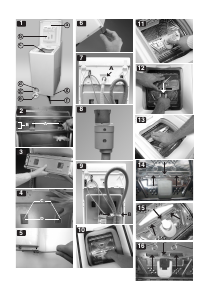
1. remove the covering panel on the front side of the machine by inserting
a screwdriver in the centre and sides of the panel and using it as a lever;
2. loosen the drainage pump cover by turning it anti-clockwise: it is
normal for some water to leak out;
3. clean the inside thoroughly;
4. screw the cover back on;
5. put the panel back in place, making sure the hooks slot in place before
pushing the panel onto the appliance.
Checking the water inlet hose
Check the inlet hose at least once a year. If it is cracked or broken, it must
be replaced: during wash cycles, the high pressure of the water could
suddenly split the hose open.
! Never use hoses that have already been used.
LOAD BALANCING SYSTEM
Before every spin cycle, to avoid excessive vibrations before every
spin and to distribute the load in a uniform manner, the drum rotates
continuously at a speed which is slightly greater than the washing
rotation speed. If, after several attempts, the load is not balanced
correctly, the machine spins at a reduced spin speed. If the load is
excessively unbalanced, the washing machine performs the distribution
process instead of spinning. To encourage improved load distribution and
balance, we recommend small and large garments are mixed in the load.
ACCESSORIES
Contact our Technical Assistance Service to check whether the following
accessories are available for this washer-dryer model.
Stacking kit
With this accessory you can secure the tumble dryer to the upper part of
your washer-dryer to save space and facilitate loading and unloading of
the tumble dryer.
TRANSPORT AND HANDLING
Do not lift the washer-dryer by gripping it from the upper section.
Unplug the appliance and close the water tap. Check that the door and
detergent dispenser drawer are tightly closed. Detach the lling hose
from the water tap then detach the drain hose. Empty all the water
remaining in the hoses and secure the latter so that they do not get
damaged during transport. Apply the transport bolts back on. Repeat, in
reverse order, the transport bolt removal procedure described in the
“Installation instructions”.
Download manual in English (PDF, 0.26 MB)
(Consider the environment and only print this manual if it is really necessary)

Loading…

Rating

Let us know what you think about the Bauknecht FWM 8F4 Washing Machine by leaving a product rating. Want to share your experiences with this product or ask a question? Please leave a comment at the bottom of the page.
Are you satisfied with the Bauknecht FWM 8F4 Washing Machine?
Yes No
Be the first to rate this product
0 votes

Join the conversation about this product

Here you can share what you think about the Bauknecht FWM 8F4 Washing Machine. If you have a question, first carefully read the manual. Requesting a manual can be done by using our contact form.

kipperer 22-05-2019
My washing machine does not load any water, it only hums twice briefly, what should I do, it is new and has the number 869991558030

reply | This was helpful (0) (Translated by Google)

More about this manual

We understand that it’s nice to have a paper manual for your Bauknecht FWM 8F4 Washing Machine. You can always download the manual from our website and print it yourself. If you would like to have an original manual, we recommend you contact Bauknecht. They might be able to provide an original manual. Are you looking for the manual of your Bauknecht FWM 8F4 Washing Machine in a different language? Choose your preferred language on our homepage and search for the model number to see if we have it available.

Specifications

Brand Bauknecht
Model FWM 8F4
Category Washing Machines
File type PDF
File size 0.26 MB

All manuals for Bauknecht Washing Machines
More manuals of Washing Machines

Frequently Asked Questions about Bauknecht FWM 8F4 Washing Machine

Our support team searches for useful product information and answers to frequently asked questions. If you find an inaccuracy in our frequently asked questions, please let us know by using our contact form.

My washing machine won't start when I press the start-button, what can I do? Verified

In many cases the door of the washing machine hasn't closed properly. Open and close the door and try again.

This was helpful (25310) Read more

My washing machine won’t drain, what can I do? Verified

The main reason a washing machine won’t drain is because of blockage in either the pump or the drain hose. If your washing machine has access to these parts, try to remove any blockage. If this does not solve the problem or if you don’t have access to these parts you should contact a mechanic or the manufacturer.

This was helpful (24071) Read more

There is no water coming into my washing machine, what can I do? Verified

Check if the water inlet is open and if there aren't any kinks in the hose of the water inlet. If this doesn't solve the problem you should contact the manufacturer.

This was helpful (9777) Read more

The door of my washing machine won't open, what can I do? Verified

There can be several causes. The most common cause is the filter being clogged. Unplug the appliance and check the filter. Remove any blockage if necessary. The location of the filter is different depening on the model. It is also possible that there is a special lever to open the door. If these options don't help, the last option is unplug the appliance for a period of 30-60 minutes and try to open the door after that. If this doesn't work, contact the manufacturer or a mechanic.

This was helpful (8353) Read more

My washing machine makes a lot of noice and/or vibrates loudly, what can I do about that? Verified

It's possible that the washing machine has not been leveled. You can do this by adjusting the feet to make it perfectly level. The problem can also be caused by inserting to much clothes in the machine. If these are not the cause of your problem you should contact the manufacturer.

This was helpful (6958) Read more

In which compartment should the detergent go? Verified

Most washing machines have 3 compartments for detergent. These compartments are often marked with I, II and * to show where the detergent goes. Compartment I is used for a pre-wash cycle, II is for the main wash cycle and * is for fabric softener. Compartment II is used most often.

This was helpful (5114) Read more

My washing machine smells, what can I do about it? Verified

There are washing machines with self-cleaning features. If these features are not available it's possible to add 100ml of white vinegar or 100gr of soda crystals and have the washing machine run a 90 ℃ program.

This was helpful (4268) Read more

Can I connect my washing machine to a warm water outlet? Verified

Although washing machines can probably handle water intake up to 65°C, this is not recommended by most manufacturers. There are wash cycles that specifically make use of cold water. In those cases warm water can harm the results of your wash cycle. Also, many washing machines are designed to be connected to a cold water outlet.

This was helpful (3048) Read more

What should I pay attention to when moving a washing machine? Verified

When moving a washing machine, you should secure the drum. You can use the transit bolt which come with every washing machine and will prevent the drum from moving around inside the machine. You also need to drain all the water.

This was helpful (1600) Read more

Can I stack my dryer and washing machine? Verified

In general it is possible to directly stack a dryer and washing machine directly on top of each other. This only works with front loading models. However, it is advisable to use a fitting accessory to do so. This will prevent the machines from vibrating and falling off and also prevents damage to the bottom machine.

This was helpful (1356) Read more

Can I connect a washing machine to an extension cord? Verified

Appliances that require large amounts of power, like a washing machine, can not be connected to all extension cords. See what the power usage of the washing machine is, which is indicated in Watt, and check if the extension cord can handle this. There are extension cords with thicker cables that are made to handle larger appliances.

This was helpful (1323) Read more

What is the difference in usage between a washer-dryer and a separate washing machine and dryer? Verified

The biggest advantage of a washer-dryer is that it takes less space. However, a separate dryer will be able to dry more than a washer-dryer. A washer-dryer also uses relatively more energy and requires more time.

This was helpful (1323) Read more
Manual Bauknecht FWM 8F4 Washing Machine

Related products

Related categories

×
Download