
5
ENGLISH
Safety Warnings Specific for Grinding and
Cutting‑Off Operations
a ) Use only wheel types that are specified for your power
tool and the specific guard designed for the selected
wheel. Wheels for which the power tool was not designed
cannot be adequately guarded and areunsafe.
Additional Safety Warnings Specific for Cutting‑Off
Operations
a ) Do not “jam” the cut‑off wheel or apply excessive
pressure. Do not attempt to make an excessive depth
of cut. Overstressing the wheel increases the loading and
susceptibility to twisting or binding of the wheel in the cut and
the possibility of kickback or wheelbreakage.
b ) Do not position your body in line with and behind the
rotating wheel. When the wheel, at the point of operation, is
moving away from your body, the possible kickback may propel
the spinning wheel and the power tool directly atyou.
c ) When the wheel is binding or when interrupting a
cut for any reason, switch off the power tool and hold
it motionless until the wheel comes to a complete stop.
Never attempt to remove the cut‑off wheel from the cut
while the wheel is in motion otherwise kickback may
occur. Investigate and take corrective action to eliminate the
cause of wheelbinding.
d ) Do not restart the cutting operation in the workpiece.
Let the wheel reach full speed and carefully re‑enter the
cut. The wheel may bind, walk up or kickback if the power tool
is restarted in theworkpiece.
e ) Support panels or any oversized workpiece to
minimize the risk of wheel pinching and kickback. Large
workpieces tend to sag under their own weight. Supports must
be placed under the workpiece near the line of cut and near the
edge of the workpiece on both sides of thewheel.
f ) Use extra caution when making a “pocket cut” into
existing walls or other blind areas. The protruding wheel
may cut gas or water pipes, electrical wiring or objects that can
causekickback.
g ) Do not attempt to do curved cutting. Overstressing the
wheel increases the loading and susceptibility to twisting or
binding of the wheel in the cut and the possibility of kickback or
wheel breakage, which can lead to seriousinjury.
b ) The grinding surface of center depressed wheels
must be mounted below the plane of the guard lip. An
improperly mounted wheel that projects through the plane of
the guard lip cannot be adequatelyprotected.
c ) The guard must be securely attached to the power
tool and positioned for maximum safety, so the least
amount of wheel is exposed towards the operator.
The guard helps to protect the operator from broken wheel
fragments, accidental contact with wheel and sparks that
could igniteclothing.
d ) Wheels must be used only for specified applications.
For example: do not grind with the side of cut‑off wheel.
Abrasive cut‑off wheels are intended for peripheral grinding,
side forces applied to these wheels may cause them toshatter.
e ) Always use undamaged wheel flanges that are of
correct size and shape for your selected wheel. Proper
wheel flanges support the wheel thus reducing the possibility
of wheel breakage. Flanges for cut‑off wheels may be different
from grinding wheelflanges.
f ) Do not use worn down wheels from larger power
tools. A wheel intended for larger power tool is not suitable for
the higher speed of a smaller tool and mayburst.
g ) When using dual purpose wheels always use the
correct guard for the application being performed. Failure
to use the correct guard may not provide the desired level of
guarding, which could lead to seriousinjury.
Kickback and Related Warnings
Kickback is a sudden reaction to a pinched or snagged
rotating wheel, backing pad, brush or any other accessory.
Pinching or snagging causes rapid stalling of the rotating
accessory which in turn causes the uncontrolled power tool
to be forced in the direction opposite of the accessory’s
rotation at the point of thebinding.
For example, if an abrasive wheel is snagged or pinched by
the workpiece, the edge of the wheel that is entering into the
pinch point can dig into the surface of the material causing
the wheel to climb out or kick out. The wheel may either
jump toward or away from the operator, depending on
direction of the wheel’s movement at the point of pinching.
Abrasive wheels may also break under theseconditions.
Kickback is the result of power tool misuse and/or incorrect
operating procedures or conditions and can be avoided by
taking proper precautions as givenbelow.
a ) Maintain a firm grip with both hands on the power
tool and position your body and arms to allow you to
resist kickback forces. Always use auxiliary handle, if
provided, for maximum control over kickback or torque
reaction during start‑up. The operator can control torque
reactions or kickback forces, if proper precautions aretaken.
b ) Never place your hand near the rotating accessory.
Accessory may kickback over yourhand.
c ) Do not position your body in the area where power
tool will move if kickback occurs. Kickback will propel the
tool in direction opposite to the wheel’s movement at the point
ofsnagging.
d ) Use special care when working corners, sharp edges,
etc. Avoid bouncing and snagging the accessory. Corners,
sharp edges or bouncing have a tendency to snag the rotating
accessory and cause loss of control orkickback.
e ) Do not attach a saw chain woodcarving blade,
segmented diamond wheel with a peripheral gap greater
than 10mm or toothed saw blade. Such blades create
frequent kickback and loss ofcontrol.
p ) Do not operate the power tool near flammable
materials. Sparks could ignite thesematerials.
q ) Do not use accessories that require liquid coolants.
Using water or other liquid coolants may result in electrocution
orshock.
r ) Do not use Type 11(flaring cup) wheels on this tool.
Using inappropriate accessories can result ininjury.
s ) When starting the tool with a new or replacement
wheel, or a new or replacement wire brush installed,
hold the tool in a well protected area and let it run for
one minute. If the wheel has an undetected crack or
flaw, it should burst in less than one minute. If the wire
brush has loose wires, they will be detected. Never start
the tool with a person in line with the wheel. This includes
theoperator.
t ) Use of accessories not specified in this manual is
not recommended and may be hazardous. Use of power
boosters that would cause the tool to be driven at speeds
greater than its rated speed constitutesmisuse.


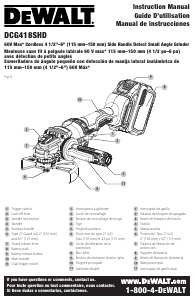


Join the conversation about this product
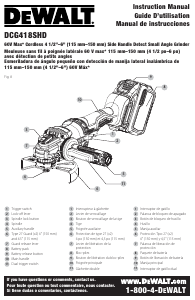
Here you can share what you think about the DeWalt DCG418SHDB Angle Grinder. If you have a question, first carefully read the manual. Requesting a manual can be done by using our contact form.