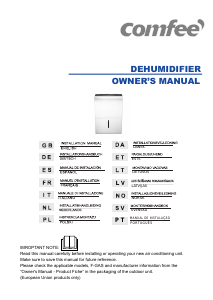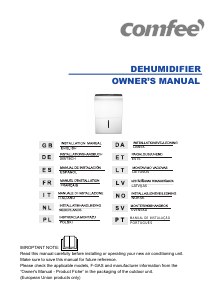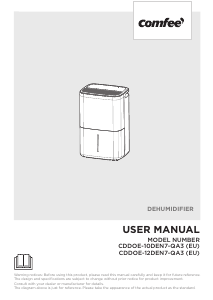
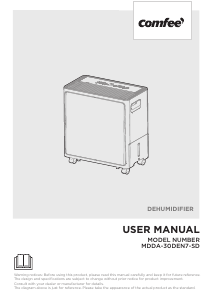
Manual Comfee CDDOE-12DEN7-QA3-(EU) Dehumidifier

Need a manual for your Comfee CDDOE-12DEN7-QA3-(EU) Dehumidifier? Below you can view and download the PDF manual for free in English. This product currently has 3 frequently asked questions, 0 comments and has 0 votes. If this is not the manual you want, please contact us.

Is your product defective and the manual offers no solution? Go to a Repair Café for free repair services.

Manual

Loading…

06
When breaking into the refrigerant circuit to make repairs or for any other purpose
conventional procedures shall be used. However, it is important that best practice is
followed since flammability is a consideration. The following procedure shall be
adhered to: Remove refrigerant; Purge the circuit with inert gas; Evacuate; Purge
again with inert gas; Open the circuit by cutting or brazing.
The refrigerant charge shall be recovered into the correct recovery cylinders. The
system shall be flushed with OFN to render the unit safe. This process may need to
be repeated several times. Compressed air or oxygen shall not be used for this task.
Flushing shall be achieved by breaking the vacuum in the system with OFN and
continuing to fill until the working pressure is achieved, then venting to atmosphere,
and finally pulling down to a vacuum. This process shall be repeated until no
refrigerant is within the system. When the final OFN charge is used, the system shall
be vented down to atmospheric pressure to enable work to take place. This
operation is absolutely vital if brazing operations on the pipe-work are to take place.
Ensure that the outlet for the vacuum pump is not close to any ignition sources and
there is ventilation available.
10.Detection of flammable refrigerants
The following leak detection methods are deemed acceptable for systems
containing flammable refrigerants. Electronic leak detectors shall be used to detect
flammable refrigerants, but the sensitivity may not be adequate, or may need
re-calibration. (Detection equipment shall be calibrated in a refrigerant-free area.)
Ensure that the detector is not a potential source of ignition and is suitable for the
refrigerant used. Leak detection equipment shall be set at a percentage of the LFL
of the refrigerant and shall be calibrated to the refrigerant employed and the
appropriate percentage of gas (25 % maximum) is confirmed.
11.Leak detection methods
Check that cabling will not be subject to wear, corrosion, excessive pressure,
vibration, sharp edges or any other adverse environmental eects. The check shall
also take into account the eects of aging or continual vibration from sources such
as compressors or fans.
9.Cabling
12.Removal and evacuation
Under no circumstances shall potential sources of ignition be used in the searching
for or detection of refrigerant leaks. A halide torch (or any other detector using a
naked flame) shall not be used.
removed/extinguished. If a leakage of refrigerant is found which requires brazing, all
of the refrigerant shall be recovered from the system, or isolated (by means of shut
o valves) in a part of the system remote from the leak. Oxygen free nitrogen (OFN)
shall then be purged through the system both before and during the brazing process.
13.Charging procedures
In addition to conventional charging procedures, the following requirements shall be
followed. Ensure that contamination of dierent refrigerants does not occur when
using charging equipment. Hoses or lines shall be as short as possible to minimise the
amount of refrigerant contained in them. Cylinders shall be kept upright.
Ensure that the refrigeration system is earthed prior to charging the system with
refrigerant. Label the system when charging is complete (if not already).
Extreme care shall be taken not to overfill the refrigeration system. Prior to
recharging the system it shall be pressure tested with OFN. The system shall be leak
tested on completion of charging but prior to commissioning. A follow up leak test
shall be carried out prior to leaving the site.
Before carrying out this procedure, it is essential that the technician is completely
familiar with the equipment and all its detail. It is recommended good practice that
all refrigerants are recovered safely. Prior to the task being carried out, an oil and
14.Decommissioning
Leak detection fluids
are suitable for use with most refrigerants but the use of detergents containing
chlorine shall be avoided as the chlorine may react with the refrigerant and corrode
the copper pipe-work. If a leak is suspected, all naked flames shall be
Download manual in English (PDF, 32.71 MB)
(Consider the environment and only print this manual if it is really necessary)

Loading…

Rating

Let us know what you think about the Comfee CDDOE-12DEN7-QA3-(EU) Dehumidifier by leaving a product rating. Want to share your experiences with this product or ask a question? Please leave a comment at the bottom of the page.
Are you satisfied with the Comfee CDDOE-12DEN7-QA3-(EU) Dehumidifier?
Yes No
Be the first to rate this product
0 votes

Join the conversation about this product

Here you can share what you think about the Comfee CDDOE-12DEN7-QA3-(EU) Dehumidifier. If you have a question, first carefully read the manual. Requesting a manual can be done by using our contact form.

More about this manual

We understand that it’s nice to have a paper manual for your Comfee CDDOE-12DEN7-QA3-(EU) Dehumidifier. You can always download the manual from our website and print it yourself. If you would like to have an original manual, we recommend you contact Comfee. They might be able to provide an original manual. Are you looking for the manual of your Comfee CDDOE-12DEN7-QA3-(EU) Dehumidifier in a different language? Choose your preferred language on our homepage and search for the model number to see if we have it available.

Specifications

Brand Comfee
Model CDDOE-12DEN7-QA3-(EU)
Category Dehumidifiers
File type PDF
File size 32.71 MB

All manuals for Comfee Dehumidifiers
More manuals of Dehumidifiers

Frequently Asked Questions about Comfee CDDOE-12DEN7-QA3-(EU) Dehumidifier

Our support team searches for useful product information and answers to frequently asked questions. If you find an inaccuracy in our frequently asked questions, please let us know by using our contact form.

Can I turn on my dehumidifier immediately after purchase? Verified

No, just like a refrigerator or freezer the device should be standing upright for at least 2 hours, but preferrably 24 hours before turning it on for the first time.

This was helpful (801) Read more

What is the ideal humidity for a living space? Verified

The ideal humidity in a house is between 40-60%. At a higher or lower humidity, fungi, bacteria and viruses are more likely to develop and you can experience personal discomfort.

This was helpful (618) Read more

How can I correctly transport my dehumidifier? Verified

Dehumidifiers should always be transported in an upright position and well protected. Any other way of transport might cause damage to the device.

This was helpful (531) Read more
Manual Comfee CDDOE-12DEN7-QA3-(EU) Dehumidifier

Related products

Related categories

×
Download